
Above all things, know thyself.
Babalon, Kurukullā, Yami, and Khandroma: The Scarlet Feminine Across Thelema, Tantra, and Hermetic Qabalah
There are certain divine images that appear again and again across cultures: the Great Mother, the terrible Mother, the lover, the initiatrix, the dancer, the devourer, and the woman who leads consciousness through death into a greater life.
In Western occultism, one of the most powerful expressions of this mystery is Babalon—the Scarlet Woman of Aleister Crowley's Thelema.
In Tibetan Vajrayana we encounter the scarlet and dancing Kurukullā, along with the larger category of the Khandroma or Dakini—the Sky Dancer, feminine embodiments of enlightened energy.
In ancient Vedic mythology we encounter Yamī, the twin sister of Yama, whose myth revolves around life, death, sexual generation, and the continuation of manifestation.
These figures are not historically the same goddess, nor should the religious systems from which they arise be casually blended together. Yet from a comparative Hermetic perspective, they reveal an extraordinary family resemblance.
Each, in a different way, stands near the mystery where:
desire becomes transformation,
death becomes initiation,
sexuality becomes creative power,
and individuality encounters something greater than itself.
Perhaps we are looking not at one historical goddess traveling secretly through every religion, but at recurring cultural manifestations of an ancient and persistent Scarlet Feminine archetype.
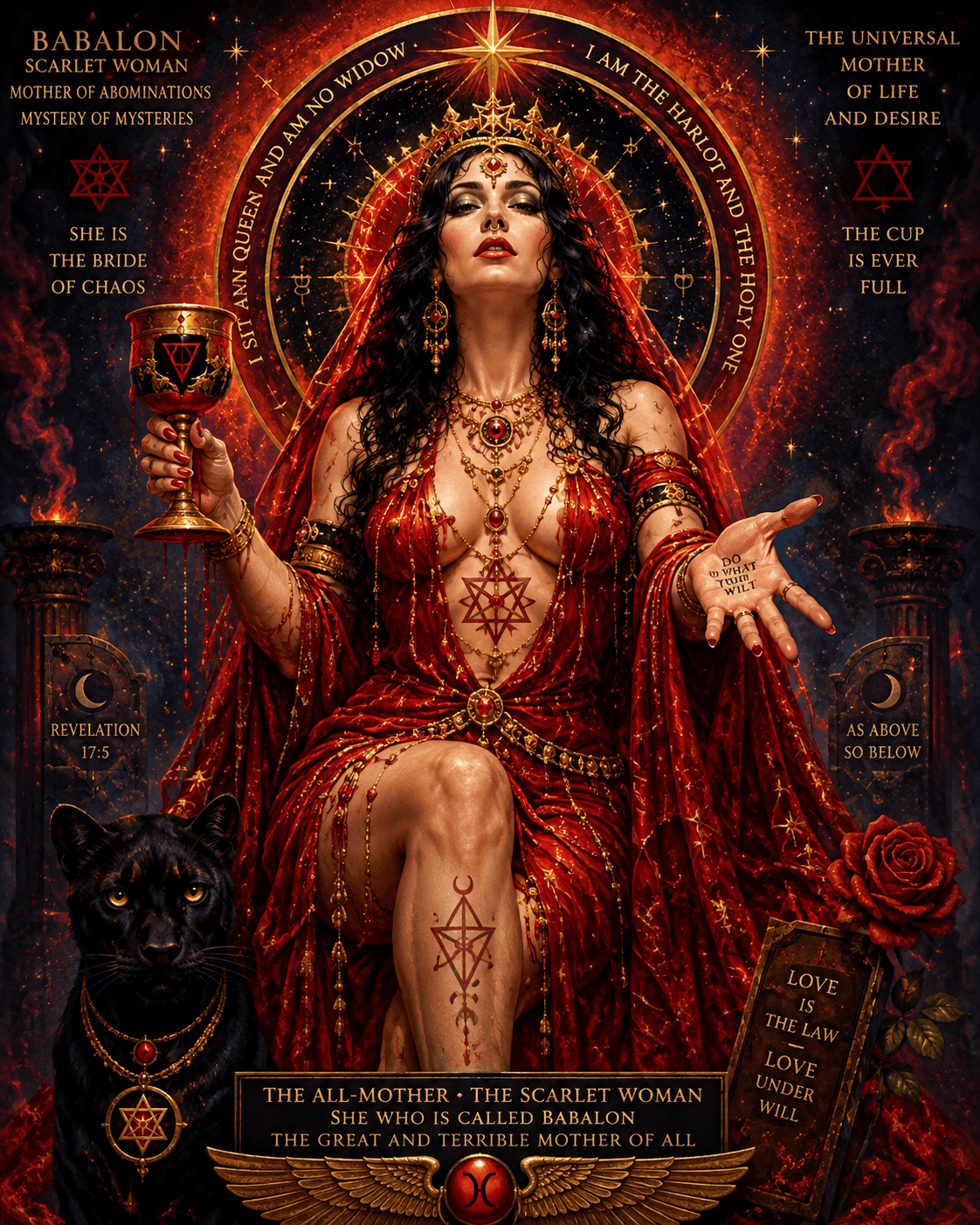
Babalon — The Scarlet Grail
Babalon is among the most profound feminine figures in Crowley's magical system.
She is called the Scarlet Woman, the Great Mother, and is intimately associated with the Grail, the Abyss, and ultimately Binah—the Third Sephira, Understanding.
In The Vision and the Voice, Crowley's vision of the Twelfth Aethyr introduces the cup containing the symbolic blood of the saints. Crowley later describes the Grail formula as one of complete renunciation: the magician metaphorically pours the last drop of individual identity into the Cup.
This is not simply sexual imagery.
It is initiatory sexuality.
Babalon represents a condition in which the isolated ego can no longer maintain the fiction that it exists independently of the Whole.
The personality says:
“I am separate.”
Babalon answers:
“Give me even that.”
Thus, the Scarlet Woman becomes simultaneously:
Mother, Lover, Grail, Abyss, and initiatrix.
Crowley's own Qabalistic system associates Babalon closely with Binah, whose traditional correspondences include Saturn, Understanding, the Great Sea, and the Supernal Mother.
This is why Babalon should not be reduced to an occult goddess of sexuality.
Her erotic symbolism represents something much larger:
the surrender of separateness.
The Grail receives everything.
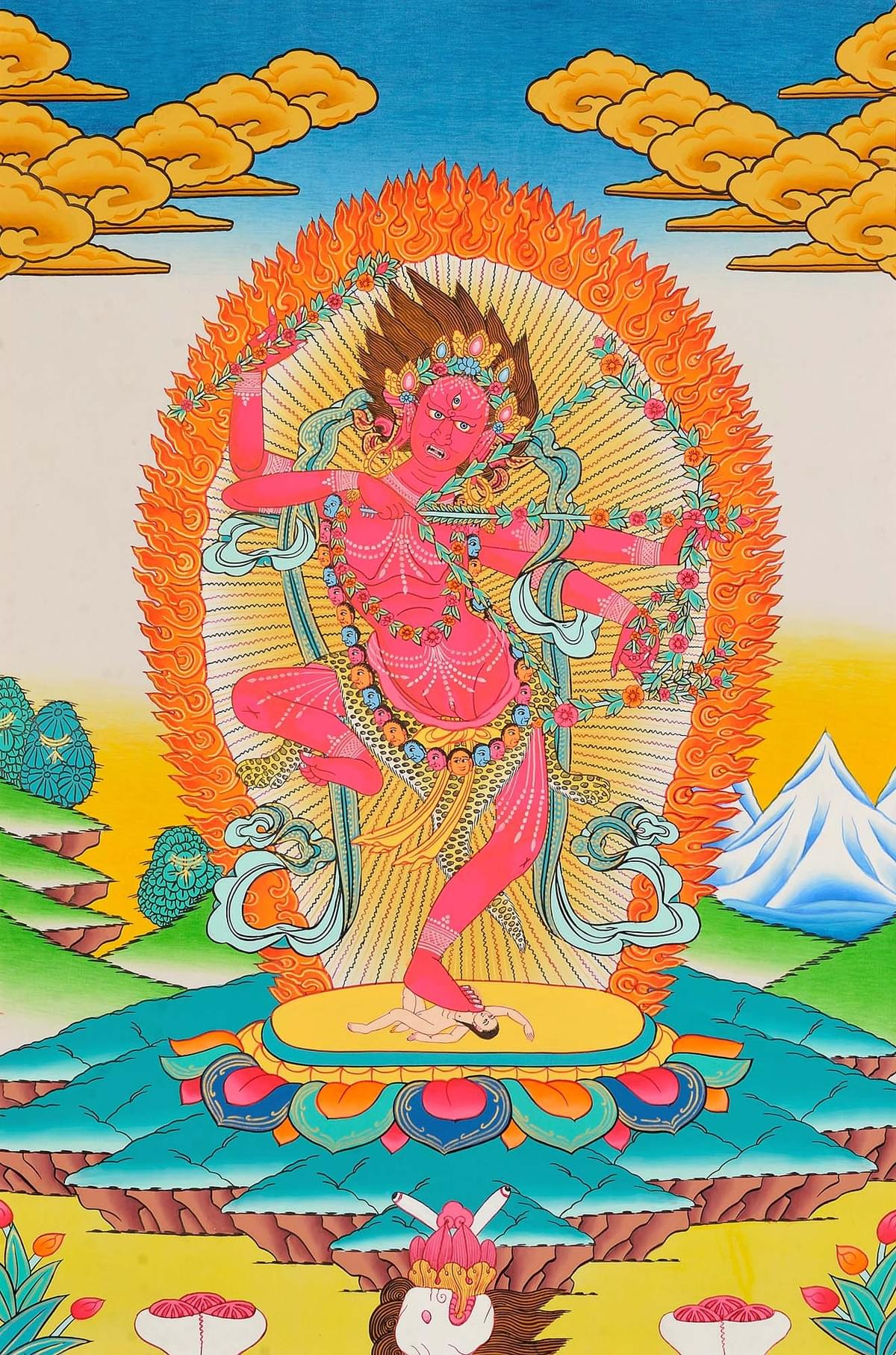
Kurukullā — The Red Dancing Power of Magnetization
Kurukullā immediately attracts the attention of anyone familiar with Babalon because the visual parallels are striking.
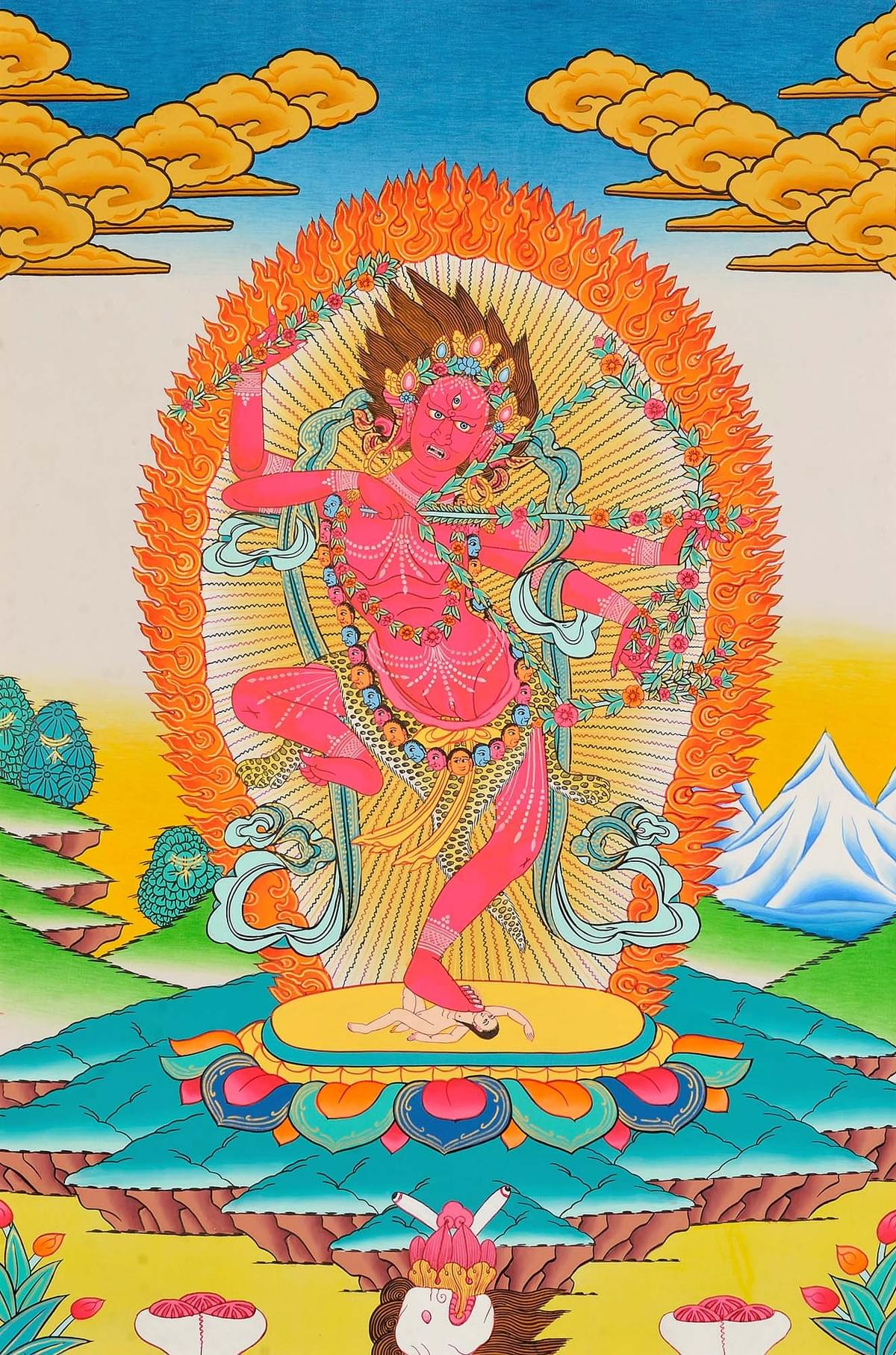
She is characteristically red, frequently depicted dancing, and often appears with four arms carrying a flower bow and arrow, hook, and noose. Traditional images place her amid flames of pristine awareness, sometimes dancing upon a corpse. Himalayan Art Resources describes her as a Goddess of Power and records traditions portraying her as a red emanation of Tara or, in other lineages, an emanation associated with Hevajra.
Her principal tantric activity is commonly classified as magnetizing.
This includes attraction, influence, charisma, subjugation of obstacles, and the transformation of desire.
The symbolism is unmistakably erotic—but again, sexuality is not the final goal.
Kurukullā shows how desire can become a vehicle rather than a prison.
Ordinary desire says:
“I want.”
Tantric transformation asks:
“What is the energy beneath wanting?”
Strip away the particular object of desire and something far more primordial remains:
attraction itself.
That force can enslave consciousness when unconscious.
But when understood, disciplined, and integrated, that same force can become magnetism, compassion, devotion, concentration, and spiritual power.
Here Western alchemy provides a useful analogy.
Kurukullā belongs naturally to the symbolism of Rubedo—the Red Work.
After dissolution and purification, the alchemical work becomes red: alive, integrated, embodied, and potent.
In this sense:
passion is not killed.
It is consecrated.
That provides our first major bridge with Babalon.
Babalon does not merely condemn desire.
Kurukullā does not merely condemn desire.
Both confront us with something much more dangerous and useful:
Desire contains enormous spiritual energy when consciousness ceases to be its unconscious servant.
Does Kurukullā Take Human Consorts?
This question deserves careful distinction.
Kurukullā is indeed associated with attraction and magnetizing activity, and some traditional descriptions make the erotic character of that activity unmistakable.
But there is no general Tibetan Buddhist doctrine stating that Kurukullā routinely selects human practitioners as supernatural husbands or personal spouses.
The broader Vajrayana tradition does, however, contain extensive symbolism surrounding consort practice, masculine and feminine principles, bliss and emptiness, and the transformation of sexual energy.
Therefore, someone encountering Kurukullā in dreams, visions, meditation, or visionary experience might experience her as intensely erotic or even relational.
That personal experience may be spiritually meaningful.
But it should be distinguished from saying:
“Traditional Buddhism teaches that Kurukullā personally marries human devotees.”
It does not.
The deeper archetypal interpretation is much more interesting anyway.
The goddess who magnetizes does not necessarily want possession of the practitioner.
She may be revealing the nature of attraction itself.
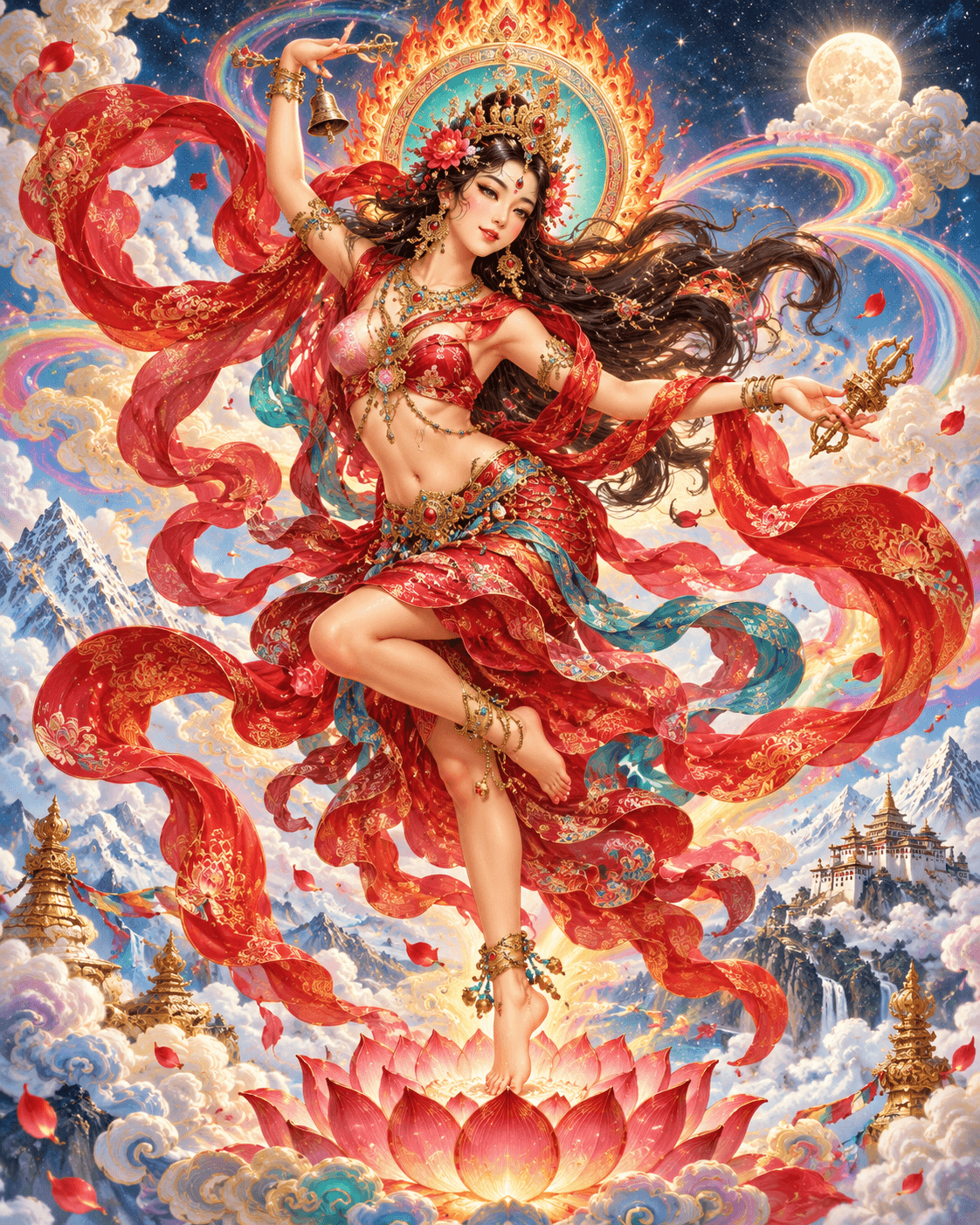
Khandroma — The Sky Dancer
The word Khandroma deserves special attention because it is frequently misunderstood.
The Tibetan term mkha' 'gro ma corresponds to the Sanskrit ḍākinī.
It literally carries the sense of a sky-goer or space-goer, and Tibetan traditions describe the dakini as a feminine embodiment of enlightened energy. The title may refer to wisdom beings, realized women, tantric figures, or different classes of dakinis depending upon context.
Therefore:
Khandroma (Pronounced Kha Dro Ma) is not necessarily the personal name of one goddess.
It is closer to a category or spiritual function.
This changes the comparison with Babalon dramatically.
Rather than saying:
Babalon = one Tibetan goddess called Khandroma
we can propose something much more sophisticated:
Babalon may resemble a Western manifestation of the same archetypal territory represented by the Wisdom Dakini.
The Dakini moves through space.
She cannot easily be contained.
She breaks conceptual rigidity.
She appears beautiful or terrifying, seductive or wrathful, peaceful or wild, because wisdom itself destroys whatever form consciousness mistakes for final truth.
This is why dancing is such an important symbol.
A seated deity represents established order.
A dancing deity represents reality happening.
The dancer cannot be frozen without destroying the dance.
She is process.
Movement.
Becoming.
Transformation.
Hence the beautiful Tibetan image of the Sky Dancer.
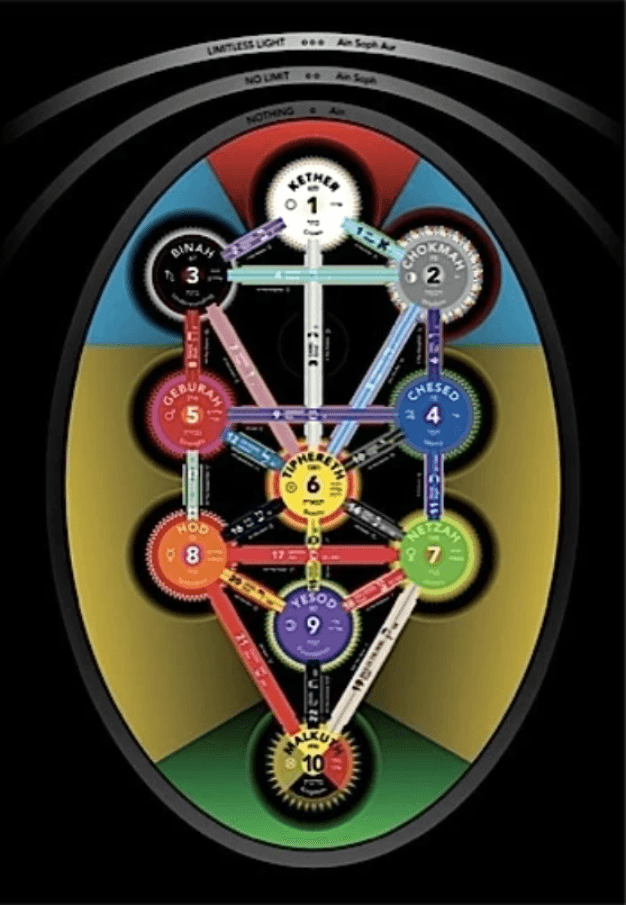
The Sky Dancer and Ain
Here Western Hermetic Qabalah offers an illuminating comparison.
Before manifestation, the Qabalistic tradition speaks of the Negative Veils:
Ain — No-Thing
Ain Soph — Limitlessness
Ain Soph Aur — Limitless Light
Then manifestation emerges through:
Kether → Chokmah → Binah
If we permit ourselves a poetic Hermetic analogy—not a Tibetan doctrinal claim—the Khandroma becomes:
She who dances through Ain.
She moves through the ungraspable field before consciousness solidifies reality into fixed definitions.
That makes the Dakini profoundly relevant to magical initiation.
The ordinary personality wants everything named:
me, mine, good, bad, safe, dangerous, sacred, profane.
The Sky Dancer passes through those walls.
And laughs.
This is why Dakini symbolism can sometimes appear shocking.
Wisdom has very little respect for the prison bars we construct from words.
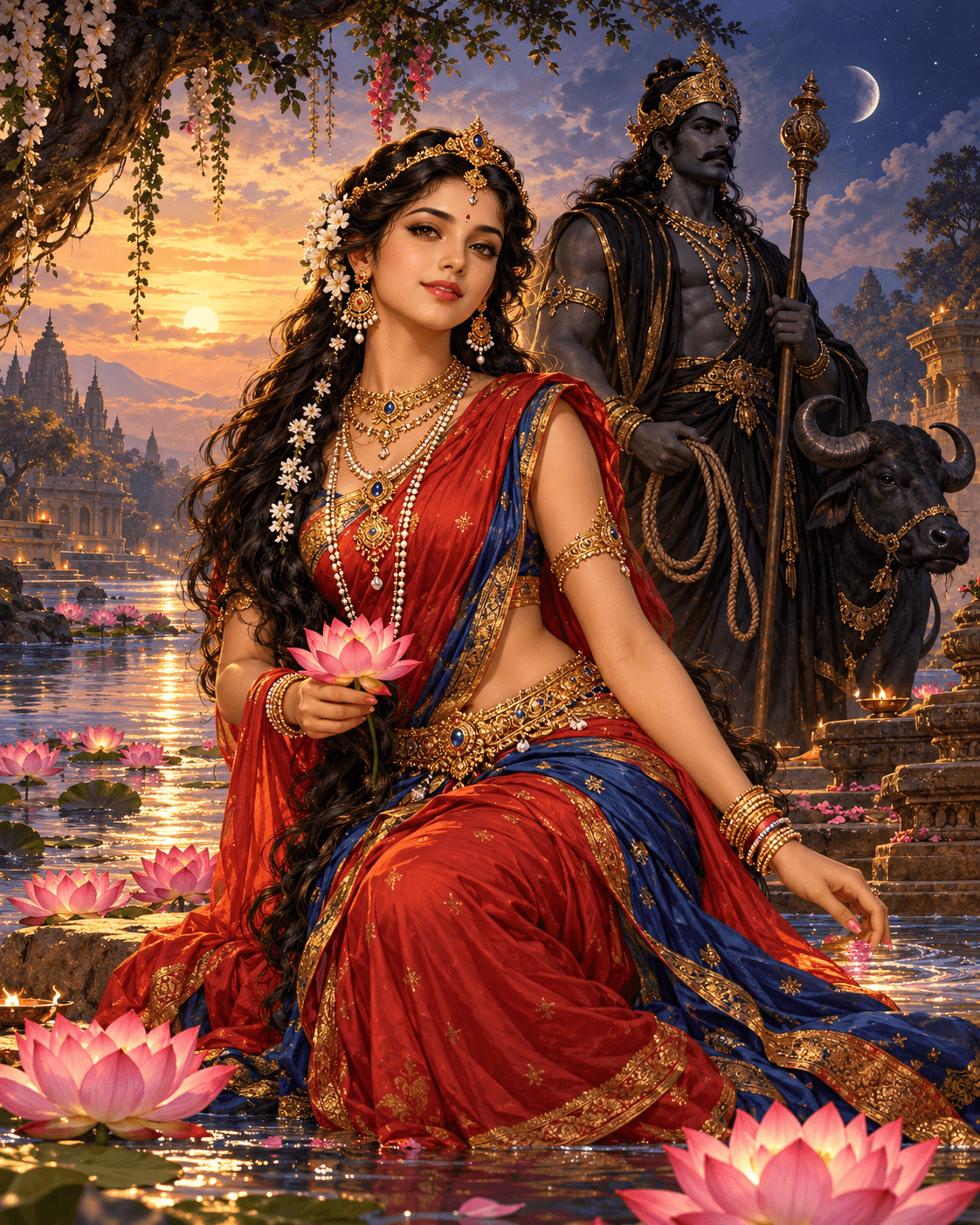
Yamī — Life Beside Death
Yamī belongs to an entirely different tradition.
She appears in the ancient Vedic world as the twin sister of Yama.
The relationship is particularly important in Rig Veda 10.10, where Yamī attempts to persuade Yama to unite sexually with her so that humanity may continue; Yama refuses the incestuous proposal. The hymn therefore places sexuality, generation, mortality, and cosmic order into direct conversation
Later traditions associate Yamī with Yamunā, the sacred river goddess.
Here we have an extraordinary polarity:
Yama — Death
Yamī — Life, continuity, generation
They are twins.
And that is exactly the point.
Life and death are not enemies.
They are siblings.
Every birth carries mortality within itself.
Every death feeds future life.
Nature knows nothing of our philosophical discomfort with the arrangement.
She simply continues.
Yamī and the Erotic Impulse
The erotic element in Yamī's mythology is especially interesting.
Her desire for union is directly connected with continuation of the human race.
That makes her sexuality fundamentally cosmogonic.
Sex is not merely pleasure.
Sex is the astonishing biological mechanism whereby mortal beings defeat death by creating life they themselves will not live.
This makes the Yama–Yamī polarity profoundly alchemical.
Yama says:
Everything formed must die.
Yamī answers:
Then life will make more forms.
Death:
Solve.
Life:
Coagula.
And the universe continues its absurdly magnificent business.
Yamī Is Not Kurukullā
This distinction matters.
Yamī is not traditionally identified as a Tibetan Red Dakini, and she should not be casually merged with Kurukullā.
Nor is Yamī historically Babalon.
They emerge from different cultures, languages, cosmologies, and religious systems.
But comparative Hermeticism asks another question:
What archetypal structure is recurring beneath these different mythologies?
There the resemblance becomes fascinating.
Yamī expresses:
life confronting death through desire and generation.
Kurukullā expresses:
desire transformed into conscious magnetizing power.
Khandroma expresses:
wisdom moving freely beyond rigid conceptual limitation.
Babalon expresses:
the ecstatic surrender of separateness into the Great Mother.
Different myths.
Different doctrines.
But perhaps similar depths of the psyche—or similar powers of consciousness.
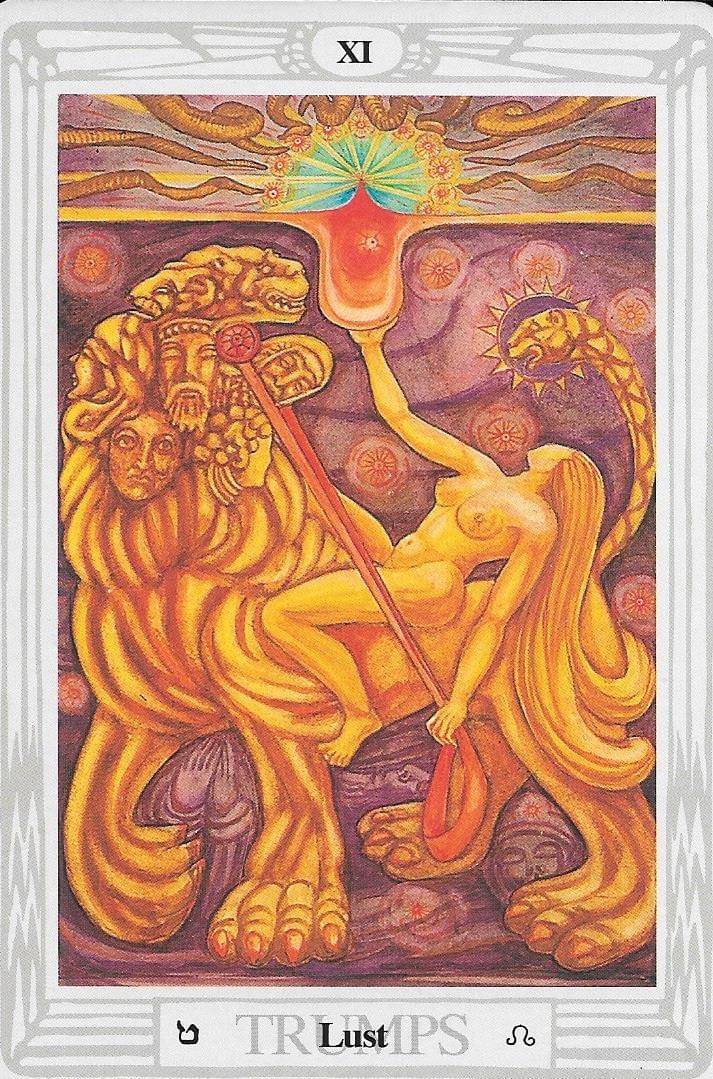
The Scarlet Feminine
When these figures are placed beside one another, a pattern emerges.
| Figure | Primary Mystery | Symbolic Function |
|---|---|---|
| Babalon | Ecstatic surrender | Grail, Great Mother, Abyss |
| Kurukullā | Magnetization | Desire transformed into power |
| Yamī | Generation beside death | Life, fertility, continuity |
| Khandroma / Dakini | Liberated wisdom | Sky, movement, awakened feminine energy |
They are certainly not identical.
But all four challenge the fantasy that spirituality means becoming pale, passionless, and disconnected from embodied existence.
Quite the opposite.
The Scarlet Feminine says:
Enter life completely enough that life itself reveals the mystery beyond the personality.
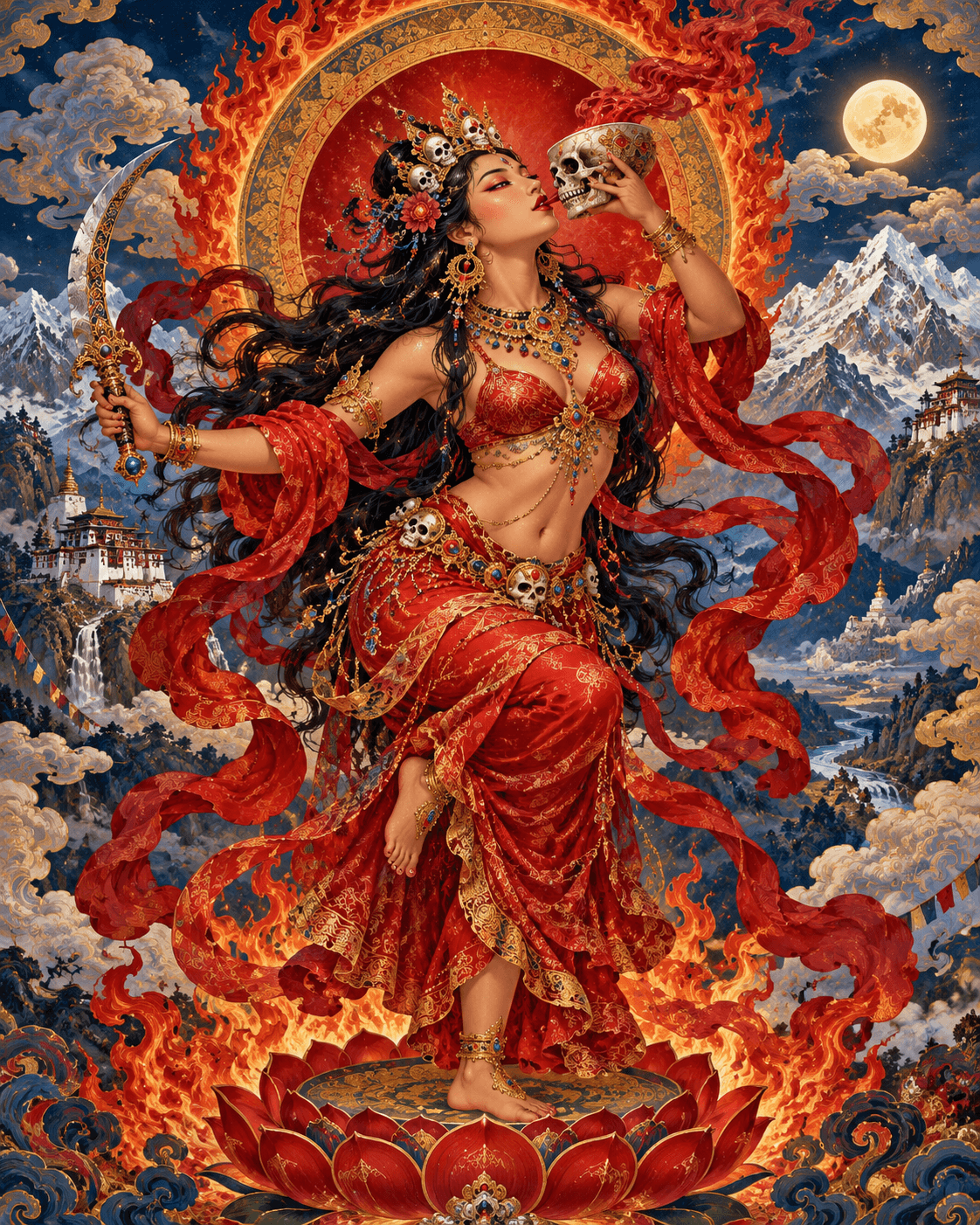
The Grail and the Skull Cup
One of the strongest symbolic bridges between Western and Tibetan imagery lies in the sacred vessel.
Babalon bears the Grail.
Tantric dakinis such as Vajrayoginī frequently carry the kapāla or skull cup.
Again, these symbols belong to different doctrines.
Yet psychologically and initiatically they approach similar territory.
The Grail receives the symbolic lifeblood of the adept.
The skull cup confronts the practitioner with impermanence, death, transformation, and the transmutation of substances ordinarily considered impure or frightening.
Both declare:
Nothing is excluded from awakening.
Even death.
Even blood.
Even desire.
Even the body.
The initiate learns one of the central truths of alchemy:
The rejected material frequently contains the missing medicine.

Binah — The Great Scarlet Womb
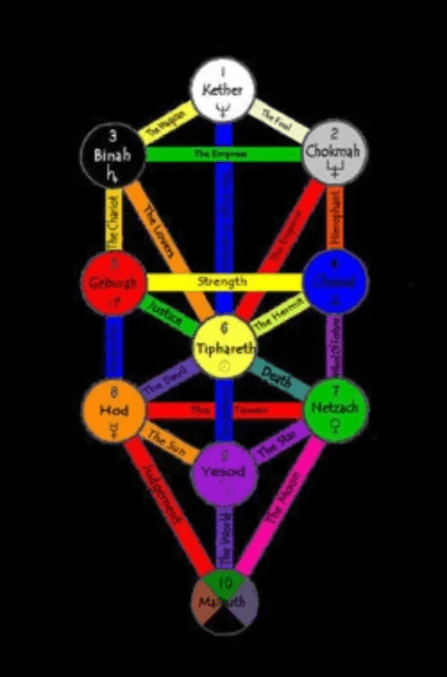
Within Western Hermetic Qabalah, the most obvious throne for Babalon is Binah.
Binah means Understanding.
She is the Great Mother, the Great Sea, and the principle that gives limitation and form to the limitless force descending from Chokmah.
She therefore contains a magnificent paradox.
Binah is the womb that gives form.
But Saturn is also attributed to Binah.
Thus, she is simultaneously:
Mother and limitation.
Birth and mortality.
Form and eventual dissolution.
Everything that enters manifestation enters time.
And everything entering time eventually leaves its present form.
The Great Mother births us.
The Great Mother receives us again.
Hence the Grail.
Kurukullā Through the Tree of Life
Kurukullā cannot simply be assigned to one Sephira, because her symbolism crosses several functions.
From a Hermetic perspective:
Netzach expresses her attraction, beauty, passion, pleasure, and magnetism.
Geburah expresses her fierceness, domination of obstacles, cutting force, and disciplined power.
Tiphareth represents the transformation of personal desire into consciously directed purpose.
And Binah provides the larger feminine matrix within which these forces become initiatory rather than merely instinctual.
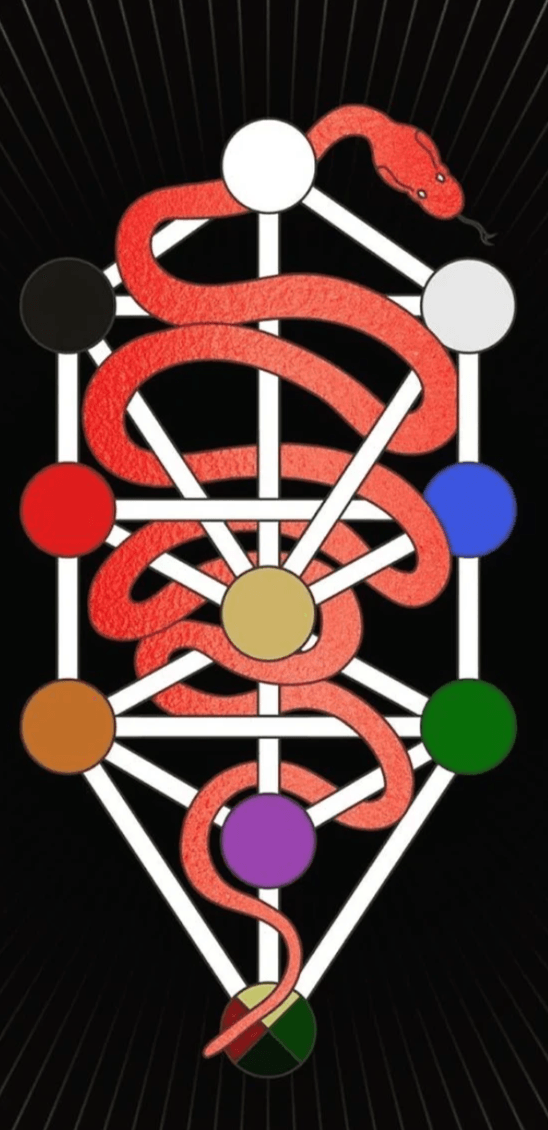
One might therefore describe the Scarlet Current descending through the Tree as:
Binah — Divine Feminine Matrix
↓
Geburah — Transformative Fire
↓
Tiphareth — Conscious Solar Integration
↓
Netzach — Desire and Attraction
When Netzach operates without Solar consciousness, desire becomes compulsion.
When Netzach is illuminated by Tiphareth:
desire becomes direction.
That is a very useful Hermetic reading of Kurukullā.
Babalon and Kurukullā: Are They the Same Entity?
Historically:
No evidence demonstrates that they originated as one goddess.
Religiously:
No traditional Tibetan teaching identifies Kurukullā with Babalon.
Symbolically:
The parallels are remarkable.
Both are strongly red.
Both are associated with feminine power.
Both contain erotic symbolism.
Both relate sexuality to transformation rather than ordinary possession.
Both undermine conventional purity taboos.
Both confront egoic control.
Both can appear fierce and beautiful simultaneously.
And both demonstrate a mystery that Western culture has often found difficult to understand:
Sexual energy and spiritual energy need not be enemies.
But their philosophical foundations remain different.
Babalon's world is Thelemic and Hermetic.
Kurukullā's world is Vajrayana Buddhist.
The first speaks prominently in terms of True Will, Grail, Abyss, and mystical surrender.
The second operates within Buddhist teachings concerning emptiness, compassion, wisdom, and transformation of afflictive energies.
Similarity is not identity.
But similarity is still worth studying.
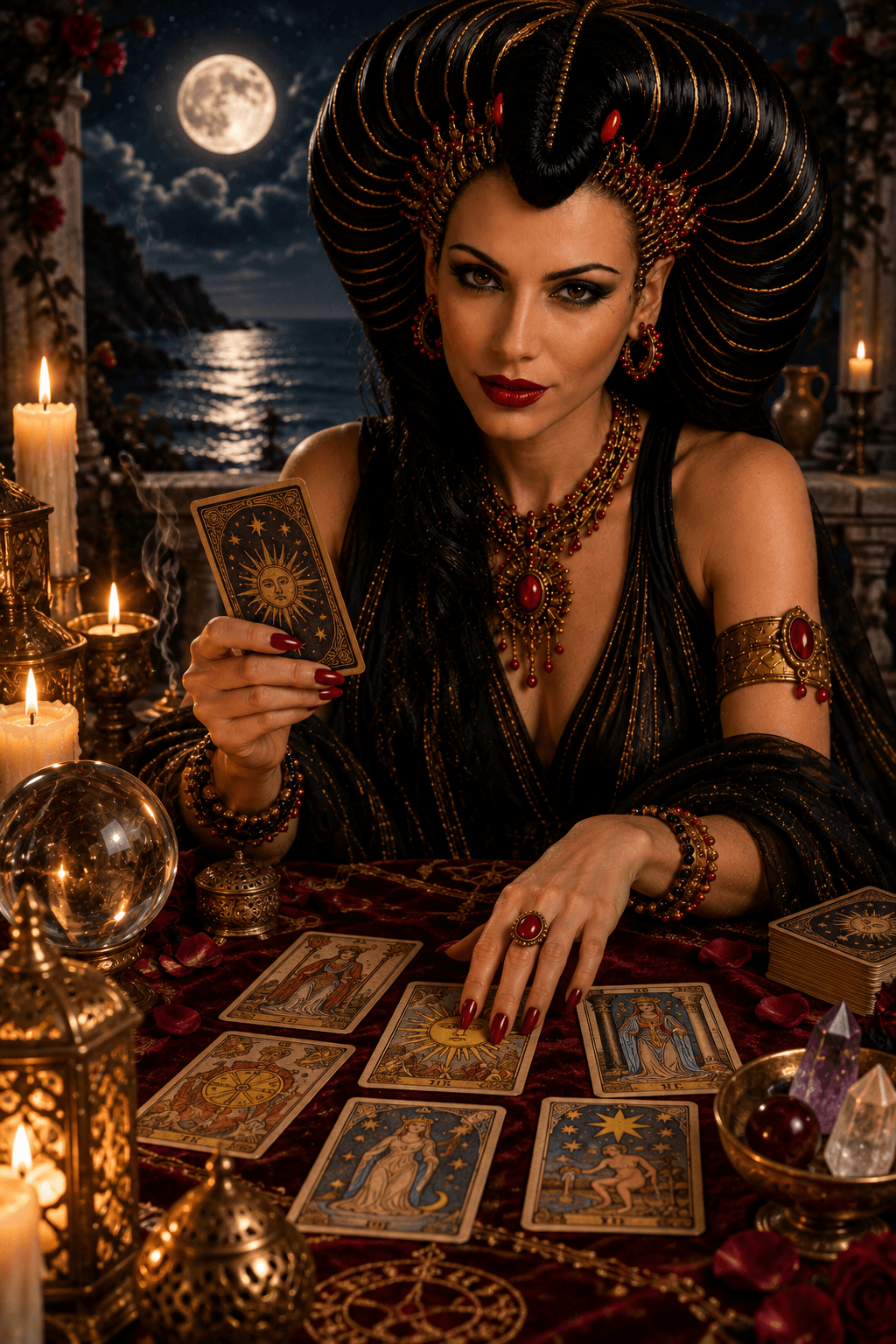
Elizabeth / Elisheba — The Name of the Oath
There is another intriguing strand in this comparison.
The Hebrew name Elisheba / Elisheva, from which Elizabeth ultimately derives, is commonly interpreted as “My God is an oath” or “God is my oath.”
In the Hebrew Bible, Elisheba is the wife of Aaron.
There is no historical connection establishing Elisheba as a name of Kurukullā, Babalon, or a Tibetan Dakini.
Nevertheless, symbolically, oath is extremely important in magic.
The magical oath is the moment when possibility becomes direction.
It binds Will.
An oath says:
“Of all possible paths, I consecrate myself to this one.”
Therefore, in a personal visionary or Hermetic interpretation, the name Elisheba could symbolize:
covenant, consecration, union, fidelity to the Work, or the binding of magician and transformative feminine power.
But that should remain a symbolic interpretation rather than being presented as historical Tibetan doctrine.
The Scarlet Current
I would give the shared archetypal pattern a useful Hermetic name:
The Scarlet Current of Transformative Wisdom
The Scarlet Current begins as desire.
But desire is only its lowest voltage.
Follow the current upward and desire becomes:
attraction
then
devotion
then
Will
then
surrender
then
wisdom.
The same energy that makes a human being say:
“I want you.”
can eventually become:
“I seek union.”
And at the highest level:
“There was never truly a separate two.”
That is where the Scarlet Woman begins approaching the Great Mother.
Yama and Yamī: The Secret of the Twins
The Yama–Yamī myth adds another dimension to this Scarlet Current.
Yama and Yamī are twins because life and death arise together.
The moment a thing becomes alive, death becomes possible.
The moment form appears, dissolution becomes inevitable.
Yet the moment death becomes inevitable, life produces offspring.
Thus:
Yama limits.
Yamī continues.
The Western alchemist would immediately recognize this as:
Solve et Coagula.
Form dissolves.
Form reappears.
The Great Work is therefore not about defeating death.
It is about discovering the consciousness that can participate knowingly in transformation.
The Dancing Goddess
Perhaps the most beautiful connecting symbol is simply:
the dance.
A throne symbolizes stability.
A dance symbolizes transformation.
The dancer exists through movement.
Freeze her movement and the dance disappears.
Thus, the Dancing Goddess teaches that Reality itself may be less like a permanent object and more like an ongoing act of becoming.
Kurukullā dances.
The Dakini crosses space.
Babalon rides the Beast.
Yamī becomes the flowing Yamunā.
None are truly static.
They are currents.
And consciousness itself may be more current than object.
A Hermetic Synthesis
If we arranged these figures into one initiatory sequence, we might obtain something like this:
Yamī — “Live.”
Enter incarnation.
Desire.
Generate.
Experience.
Kurukullā — “Know desire.”
Stop being unconsciously dragged by attraction.
Learn its force.
Direct it.
Khandroma — “Become free.”
Release rigid definitions.
Move through conceptual space.
Dance rather than petrify.
Babalon — “Surrender even the one who became free.”
Pour the final illusion of separateness into the Grail.
This gives us an extraordinary alchemical progression:
Birth → Desire → Transformation → Liberation → Surrender
or:
Yamī → Kurukullā → Khandroma → Babalon
Not as an ancient historical lineage.
But as a modern comparative Hermetic map.
Tiphareth and the Scarlet Goddess
There is also an important place for Tiphareth.
The ordinary personality cannot safely integrate powerful erotic, psychic, or archetypal forces merely by indulging them.
Something must provide a center.
That center is Tiphareth:
Beauty.
Solar equilibrium.
The seat of the Higher Self in Western Hermetic psychology.
Without Tiphareth, Netzach's passion can become obsession.
Geburah's power can become cruelty.
Hod's interpretation can become delusion.
Yesod's imagery can become fantasy mistaken for objective reality.
Tiphareth provides the Solar balance through which the magician can say:
“This experience is real as experience. Now what does it teach?”
That is much more powerful than either blind belief or blind dismissal.
The Magus need not immediately declare every vision an external deity.
Nor must the Magus reduce every godform to “nothing but psychology.”
Instead:
Observe. Record. Compare. Test. Integrate.
That is spiritual science worthy of Hermes.
The Scarlet Feminine and the False Ego
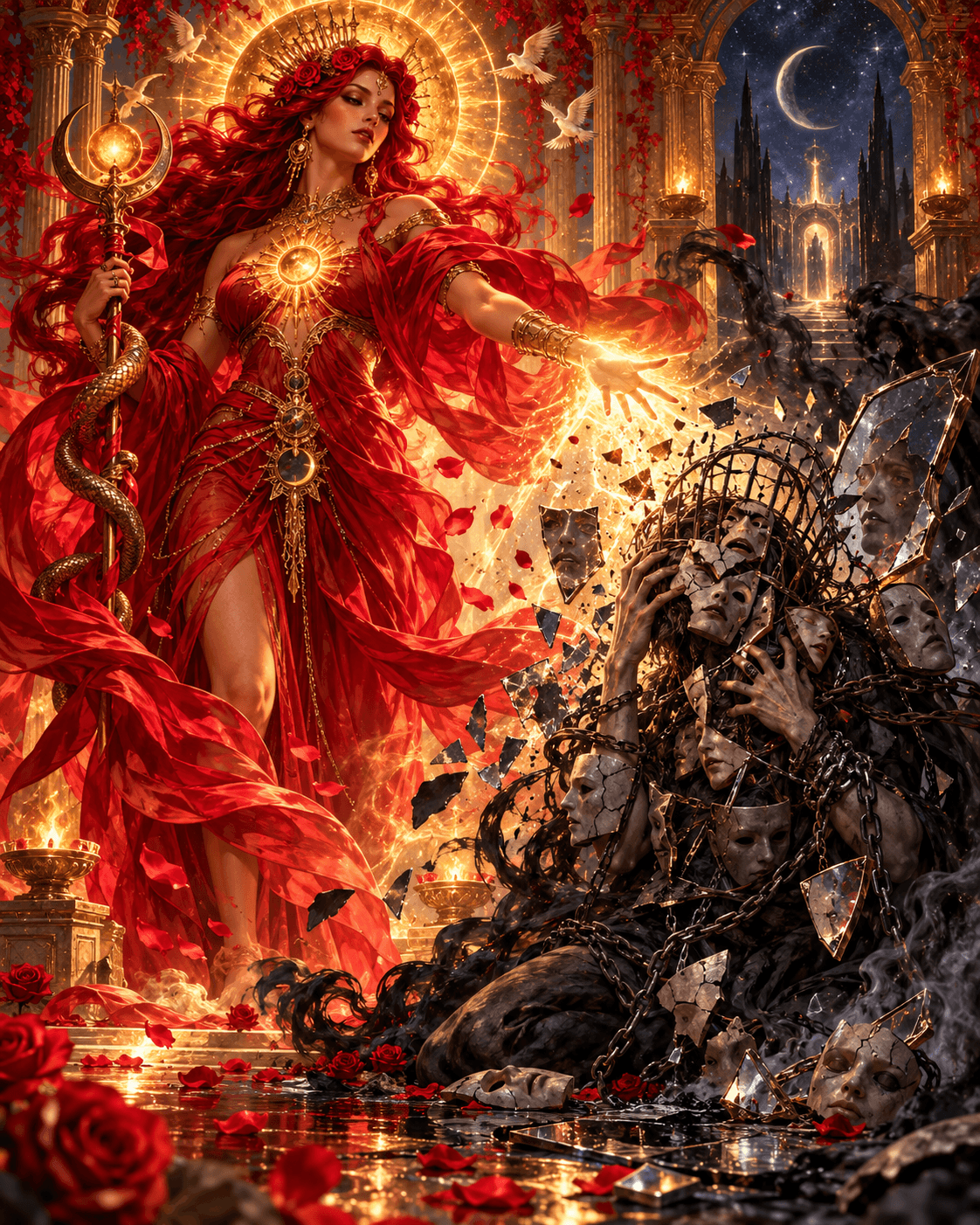
The Scarlet Feminine repeatedly attacks one particular illusion:
the false personality's belief that it owns consciousness.
The conditioned personality says:
“I am the thinker.”
But thoughts appear before we consciously manufacture most of them.
It says:
“I control desire.”
Yet desire regularly surprises us.
It says:
“I am permanent.”
Yet personality changes continuously.
Hence the terror and fascination surrounding figures like Babalon and the Dakini.
They threaten the imaginary monarch sitting inside the skull.
The Scarlet Goddess walks into the throne room and asks:
“And exactly who crowned you?”
There is our salting of humor.
The Great Scarlet Mystery
So, are Babalon, Kurukullā, Yamī, and Khandroma one supernatural woman wearing four costumes?
We cannot responsibly claim that as historical fact.
But we can say something equally fascinating.
Human beings separated by enormous stretches of geography and history repeatedly encountered a feminine sacred power connected with:
desire, blood, life, death, transformation, liberation, attraction, wisdom, and ecstatic transcendence.
Western Hermeticism permits us to place those images beside one another without pretending their traditions are identical.
And when we do, a Scarlet archetype becomes visible.
She is:
the Mother who births form,
the Lover who awakens desire,
the Sorceress who magnetizes consciousness,
the Dakini who dances through conceptual space,
the River that defeats death by continuing to flow,
and the Grail into which even the accomplished Magus must finally surrender.
Perhaps that is why the Scarlet Woman remains both seductive and terrifying.
She asks us for something far more difficult than worship.
She asks us to transform.
The Hermetic Formula of the Scarlet Current
Yamī: Life desires continuation.
Kurukullā: Desire becomes conscious power.
Khandroma: Power becomes liberated wisdom.
Tiphareth: Wisdom recognizes its Solar center.
Babalon: Even the Solar self is surrendered into the Great Mother.
Ain: No-Thing remains.
And from that No-Thing—
the dance begins again.
Solve et Coagula.
Above all things, know thyself.

Thank you for spending some time exploring the Tarot with me. Your interest, thoughtful comments, and supportive donations are deeply appreciated and help keep this work growing. May wisdom light your path, may prosperity walk beside you, and—as always—may you live long and prosper.
3 Western Hermetic Tarot and Magick websites helping people become more magick and less tragic since 2010.
