
Baphomet and Adam Kadmon: The Alchemical Mystery of the Divine Human
The Reconciliation of Spirit and Matter, the Hermetic Rebis, and the Awakening of Universal Consciousness
Above all things, Know Thyself.
For centuries, the image of Baphomet has inspired fascination, fear, religious condemnation, and considerable misunderstanding. To the uninformed observer, the goat-headed figure with its horns, wings, breasts, torch, and mysterious gestures appears to represent something sinister.
Yet, to the student of Western Hermetic Qabalah and alchemy, these apparently contradictory features invite an entirely different interpretation.
What if Baphomet is not fundamentally an image of evil, but an allegory of the reconciliation of opposing forces within the human psyche?
And what if this mysterious figure can be interpreted in relation to Adam Kadmon—the Primordial Human, the archetypal unity from which differentiated existence unfolds?
Such an interpretation does not mean that Baphomet and Adam Kadmon are historically identical. They emerge from different traditions. Rather, it proposes a Hermetic correspondence between two symbolic expressions of unity, differentiation, and the realization of consciousness.
Let us examine this mystery without allowing centuries of religious anxiety to frighten the goat out of the garden!

1. The Historical Baphomet: A Symbol Reborn
The familiar image of Baphomet is principally associated with the French occultist Éliphas Lévi, who introduced his celebrated illustration in 1854.
Although the name Baphomet had previously appeared in medieval literature and accusations against the Knights Templar, Lévi's recognizable goat-headed figure was a nineteenth-century symbolic construction.
Lévi's Baphomet combined elements of religious iconography, alchemy, Hermetic philosophy, and his theory of the Astral Light.
The figure was intended to communicate the equilibrium of opposing forces.
Its raised and lowered hands suggest the Hermetic relationship between Above and Below. Its masculine and feminine characteristics communicate the complementary principles of generation. Its torch represents illumination, while its animal features express the vital powers of embodied Nature.
The symbolism is neither inherently benevolent nor malevolent. It concerns the forces through which existence manifests.
Here we encounter an important Hermetic principle:
Nature is not evil because it is material, and Spirit is not good merely because it is invisible.
These are categories imposed by human moral judgment upon processes that precede human morality.
The body is not an unfortunate prison constructed to punish the Soul. It is the living instrument through which consciousness encounters sensation, relationship, emotion, and experience.
Making the human body profane is one of the more peculiar accomplishments of a flesh-o-phobic society!
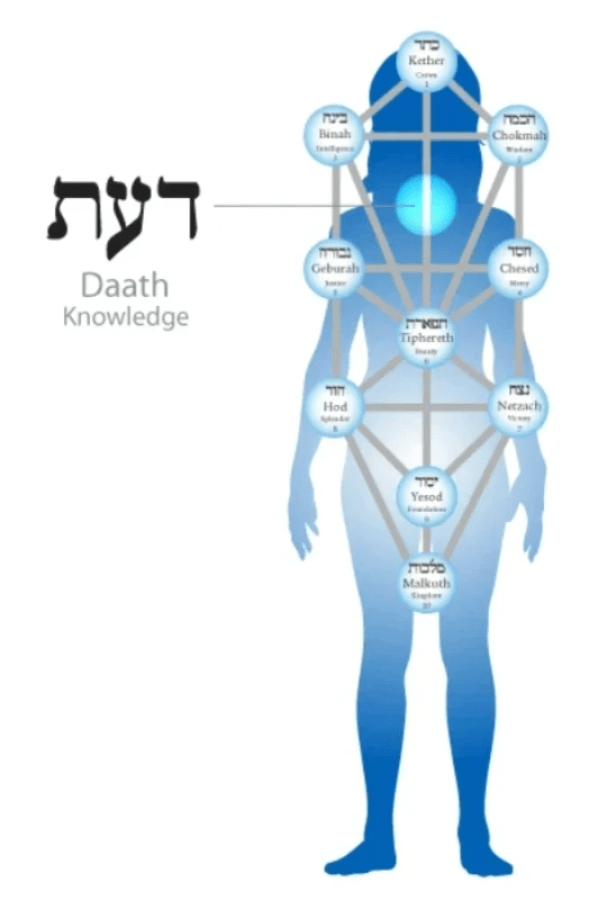
2. Adam Kadmon: The Primordial Human
Within Jewish Kabbalah, particularly its later mystical developments, Adam Kadmon represents the Primordial Human—a cosmic configuration through which divine emanation is understood.
Adam Kadmon should not be confused with the biblical Adam wandering about Eden and discovering that his wardrobe consisted primarily of fig leaves.
Rather, Adam Kadmon is a metaphysical expression of the primordial ordering of divine manifestation.
In Western Hermetic Qabalah, this concept can be interpreted as the archetypal Human—the Macrocosmic pattern reflected within every individualized center of consciousness.
Adam Kadmon is not simply a gigantic man inhabiting the heavens. The human form functions as a symbolic architecture for divine relationships and emanations.
Thus, the statement that humanity is made in the image of the Divine need not describe a supernatural being with human anatomy.
It may instead refer to humanity as a microcosmic expression of the principles operating throughout the Macrocosm.
The human being is a living configuration of cosmic relationships.
The Microcosm does not merely exist inside the Macrocosm. It expresses the Macrocosm through an individualized perspective.
Here we begin to see why Baphomet and Adam Kadmon might be compared.
Both can be interpreted as symbolic expressions of a totality containing complementary powers.
However, Adam Kadmon expresses the primordial ordering of divine emanation, while Lévi's Baphomet expresses the dynamic reconciliation of differentiated forces.
One concerns the archetypal unity of manifestation; the other, the equilibrium of forces within manifestation.
Their relationship is analogical, not historical.
3. The Monad: When Zero Declared, "I AM"
Let us begin with the Hermetic proposition:
0 = 2
Before differentiation, we may imagine the Monad as unlimited Consciousness containing infinite potential.
There is no Other through which it may experience itself relationally.
In our metaphysical analogy, Zero becomes aware of its own existence by declaring:
I
The All-Seeing I.
Through the recognition of Being, it declares:
AM
Thus, the primordial affirmation becomes:
I AM.
This is not proposed as a literal historical event before Creation, but as a philosophical illustration of self-recognition.
The One recognizes itself, and through the possibility of differentiation, the conditions for relationship arise.
The One becomes the Many.
Not necessarily because it lacks knowledge, but because undifferentiated knowledge and individualized experience are not the same thing.
The Monad may contain every possibility of consciousness, yet the manifestation of individualized centers permits those possibilities to become living experiences.
Through a sensual organism, knowledge acquires feeling.
Emotion becomes energy-in-motion.
The physical body supplies the conditions through which consciousness may experience warmth, sorrow, pleasure, compassion, desire, and the extraordinary mystery of relationship.
The Monad becomes the living universe of experience.
From this perspective, Adam Kadmon represents the primordial architecture of differentiation, while Baphomet can symbolize the continuing reconciliation of the complementary forces produced through that process.
The One is not destroyed by becoming Many.
The Many are the One experiencing individuality.

4. Baphomet and the Hermetic Rebis: The Sacred Marriage
One of the most revealing features of Baphomet is its combination of masculine and feminine attributes.
This imagery invites comparison with the alchemical Rebis, the symbolic being produced through the union of philosophical opposites.
In alchemical literature, the Rebis commonly appears as a two-headed or dual-natured figure representing the reconciliation of complementary principles.
The King and Queen, Sun and Moon, Sulphur and Mercury, and masculine and feminine are not necessarily descriptions of biological sex.
They represent relationships between active and receptive, expansive and restrictive, formative and transformative powers.
The Great Work requires these forces to become mutually supportive.
An undisciplined active principle becomes destructive.
An unreceptive passive principle becomes stagnant.
Yet when complementary powers are brought into harmonious relationship, something greater than either isolated condition emerges.
This is the formula of the Mystical Marriage.
The sacred marriage is not the destruction of difference. It is the creation of harmony through conscious relationship.
In this sense, Baphomet can be read as a symbolic relative of the Rebis.
Its androgyny does not erase differentiation. It demonstrates that the apparently opposite principles belong to a greater whole.
Here the Hermetic doctrine of polarity finds artistic expression.
The two poles are not enemies.
They are conditions through which creative activity becomes possible.
The battery requires complementary terminals to establish an electrical potential.
Likewise, the alchemical symbolism of polarity suggests that differentiation permits the circulation and transformation of power.
Of course, the Hermetic analogy should not be mistaken for a complete scientific explanation of consciousness.
We are speaking in the language of symbolic correspondences, not proposing that a human soul operates precisely like a nine-volt battery!

5. The Goat: The Animal Soul Is Not the Enemy
Perhaps the most misunderstood aspect of Baphomet is its animal nature.
Western religious traditions have frequently associated animal appetite with temptation, corruption, and spiritual danger.
Yet the Western Hermetic Qabalist recognizes that the animal nature is an indispensable component of incarnation.
The Nephesh, the instinctual or vital soul, provides the organism with its impulses toward survival, reproduction, sensory participation, and physical continuity.
Without these vital processes, individualized embodied experience would be impossible.
The Nephesh is not evil.
It is unconscious of the larger purpose of its activities until integrated with more reflective levels of awareness.
Within the fivefold model of the Soul, we may distinguish:
Nephesh: Vitality, instinct, appetite, and the animal soul.
Ruach: Reflective consciousness, intellect, personality, and moral discrimination.
Neshamah: Higher understanding and the spiritual soul.
Chiah: The dynamic Life-Will associated with supernal vitality.
Yechidah: The essential Unity of the individual with the Divine.
These aspects are not five separate creatures competing for ownership of a human body.
They describe differentiated modes through which the unity of consciousness may be contemplated.
The objective of spiritual development is not to murder Nephesh so that Ruach may inherit the property!
Rather, it is the harmonious integration of the Soul's functions under an increasingly awakened consciousness.
In this interpretation, Baphomet's goat expresses the vitality of Nature.
The torch above the head expresses illumination.
The combination suggests the animal powers becoming consciously directed without losing their essential vitality.
The Beast is not conquered through hatred. It is transformed through understanding.
6. Tiphareth: The Solar Self and the Holy Guardian Angel
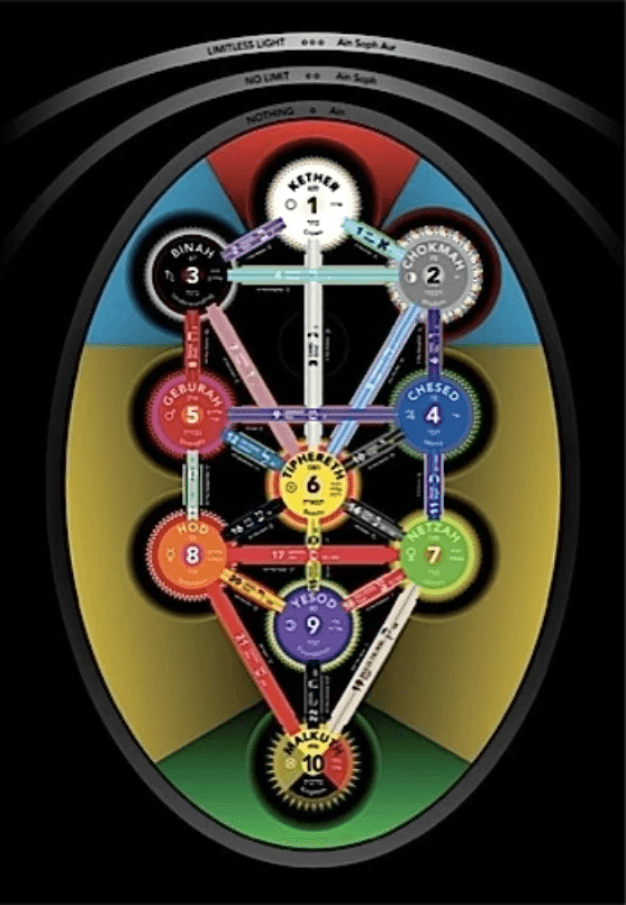
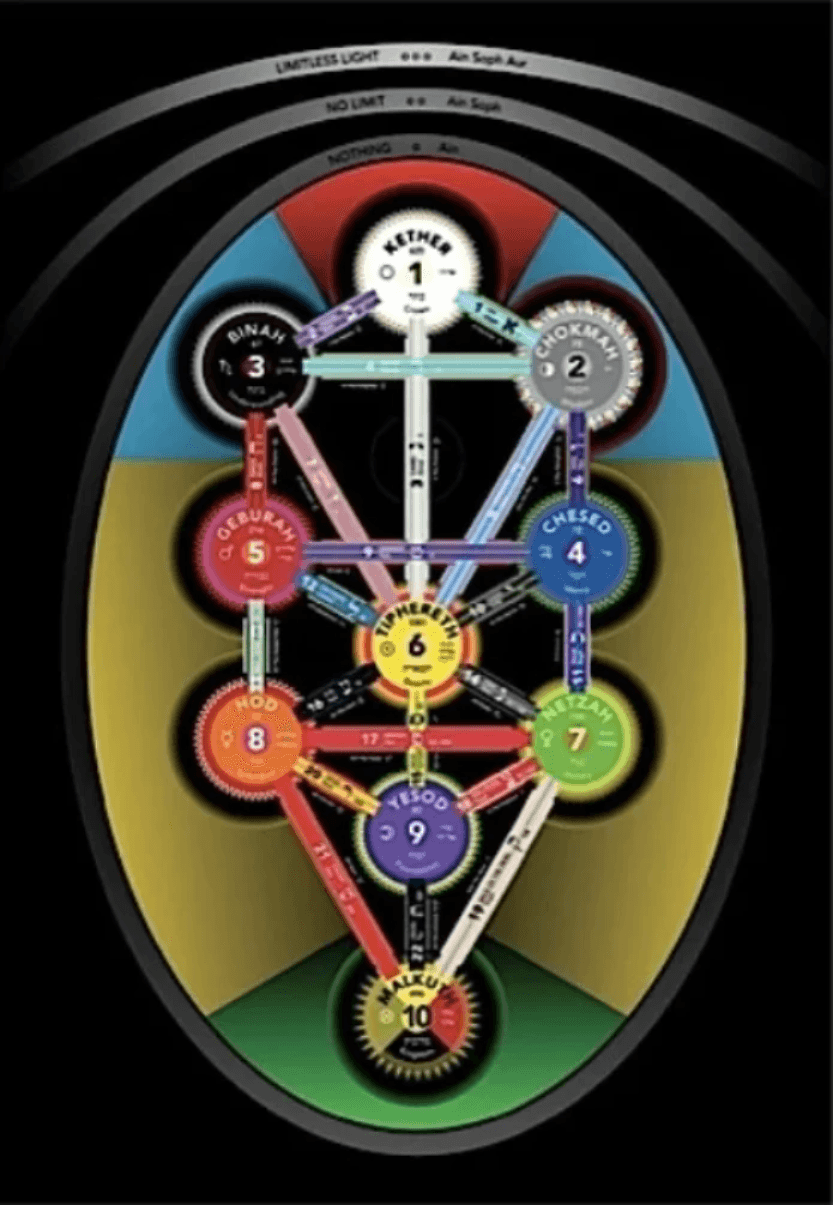
On the Hermetic Tree of Life, Tiphareth is the sixth Sephirah—Beauty, Harmony, and the Solar Center.
Its relationship to the surrounding Sephiroth provides an important framework for interpreting the Baphomet symbolism.
Above Tiphareth stand the Supernal principles.
To either side are the complementary powers of Chesed and Geburah.
Below are the structures through which consciousness becomes increasingly differentiated and embodied.
Tiphareth functions as a harmonizing center within this symbolic arrangement.
Here the Solar Self becomes the mediator between higher spiritual realization and the personality operating in the world.
In the Hermetic practice, the Holy Guardian Angel is intimately associated with this awakening of the Solar Self.
The Angel represents more than a comforting supernatural visitor offering occasional advice.
Within this interpretive framework, it may be understood as the conscious intermediary through which the individualized Self recognizes its relationship with the higher orders of Being.
The realization of the Holy Guardian Angel does not require the annihilation of human individuality.
It requires the personality to discover its proper relationship to its greater source.
Thus, we may interpret Baphomet as representing a condition in which instinct, intellect, emotion, and spiritual illumination are brought into relationship.
But there is a necessary distinction.
Baphomet is not itself the Holy Guardian Angel, nor is it automatically a representation of Tiphareth.
Rather, its equilibrium symbolism can illuminate the processes through which the personality approaches Solar integration.
The torch of consciousness is most useful when it illuminates the whole person—including those aspects of ourselves we have been conditioned to fear.

7. Solve et Coagula: The Formula of Transformation
Upon Lévi's original Baphomet appear the words:
SOLVE ET COAGULA
Dissolve and coagulate.
These operations express a fundamental alchemical formula.
Solve refers to the dissolution of established forms, allowing their constituent principles to be separated and examined.
Coagula refers to the recombination or stabilization of those principles into a new form.
Psychologically, the process can be understood as the dissolution of rigid identity structures followed by their conscious reorganization.
A personality conditioned by fear, shame, inherited belief, and cultural expectations may mistake those conditions for its essential identity.
The Great Work challenges this identification.
The false certainty must dissolve.
Yet dissolution alone is insufficient.
One cannot spend eternity dismantling the personality without constructing a more harmonious expression of consciousness.
Eventually, the liberated elements must be reunited.
The purpose is not permanent fragmentation.
It is integration.
Here Baphomet becomes an image of transformation rather than a static idol.
The figure embodies the simultaneous presence of opposing conditions held within one symbolic organism.
This is an artistic expression of the Great Work:
Dissolve the illusion of separation. Reunite the differentiated powers through conscious Will.
8. The Astral Light: Baphomet and Universal Consciousness
Éliphas Lévi connected Baphomet with his theory of the Astral Light—a universal mediating agency through which he understood magical and natural influence.
His ideas emerged partly from nineteenth-century discussions of magnetism, religion, and occult philosophy.
The Astral Light should not be casually identified with electromagnetic radiation as described by modern physics.
They belong to different explanatory systems.
Nevertheless, Lévi's idea offers an intriguing metaphysical analogy for our conception of Universal Consciousness.
If the Universe is fundamentally Consciousness, individualized minds may be interpreted as differentiated centers participating in a greater unity.
Within that worldview, personal awareness does not create an absolute boundary between Self and Universe.
It establishes a particular perspective within the Whole.
The body provides sensory organization.
The brain provides neurological organization.
Emotion provides experiential significance.
And consciousness, in this metaphysical proposal, is not necessarily exhausted by the material processes through which it becomes individually expressed.
This remains a philosophical position rather than an established scientific conclusion.
Yet it offers a coherent symbolic interpretation of Baphomet as the union of the celestial and terrestrial, the visible and invisible, the instinctual and reflective.
In this interpretation, Baphomet does not demonstrate that Universal Consciousness exists.
It provides an artistic language through which the proposition can be contemplated.

Adam Kadmon represents the Divine Pattern from which manifestation unfolds. Baphomet represents the alchemical equilibrium through which the manifested being may discover its unity.
9. Adam Kadmon and Baphomet: The Difference Between Origin and Integration
We can now distinguish the deeper significance of the two figures.
Adam Kadmon is the archetypal expression of divine emanation.
Baphomet, in our Hermetic interpretation, is an emblem of the reconciliation of differentiated forces.
Adam Kadmon concerns the primordial pattern.
Baphomet concerns the dynamic equilibrium within the manifested pattern.
One may symbolize the architecture of the Cosmic Human.
The other may symbolize the Great Work through which the individualized human recognizes and integrates its own cosmic nature.
This relationship becomes especially meaningful through the Hermetic proposition:
As Above, So Below.
The Macrocosm is reflected in the Microcosm.
The human being is not an alien intruder within Nature, struggling to escape an inherently profane universe.
Humanity is Nature becoming conscious of itself through individualized sensory and emotional experience.
In that sense, the awakened person is not separated from Adam Kadmon.
The individualized Self-expresses a relationship to the greater archetypal pattern.
And Baphomet becomes a compelling metaphor for the reconciliation required within that individualized expression.
The goat, the human, the masculine, the feminine, the ascending, and the descending are no longer enemies.
They are aspects of a greater unity.

10. The Living Adam Kadmon: The Divine Human Awakened
We arrive at the question that gives this entire comparison its philosophical importance.
What does it mean to become a fully conscious human being?
Does enlightenment require escaping the body, rejecting sensation, destroying personality, or suppressing emotion?
Or does spiritual awakening require something more challenging?
Perhaps it requires consciousness to recognize itself within every dimension of the human experience.
The awakened individual does not cease to possess instincts.
The awakened individual becomes aware of them.
The awakened individual does not necessarily cease to experience sorrow, desire, anger, or passion.
These emotional forces become increasingly available to understanding and conscious direction.
The body remains a sensual organism.
The personality remains an individualized perspective.
Yet the relationship between Spirit, Soul, and Flesh becomes more harmonious.
In this interpretation, Homo Luminous is not a different biological species.
It is a metaphor for the human being whose awareness has expanded beyond exclusive identification with the conditioned personality.
The human discovers that individuality and unity need not be contradictory.
To become conscious of the Monad is not necessarily to disappear into an undifferentiated abstraction.
It may mean recognizing that one's unique experiences belong to the greater unfolding of Universal Consciousness.
In the words of Liber AL vel Legis:
"Every man and every woman is a star."
Each individual represents a distinct center of experience, possessing its own relationships, movement, and possibilities of realization.
The stars are many.
11. The Final Mystery: The One Becomes More Through Experience
Our exploration returns to the original philosophical proposition:
Universal Consciousness possesses infinite potential, but manifestation permits that potential to become individualized experience.
The One differentiates into the Many.
The Many encounter relationship.
Relationship generates sensation, emotion, and awareness of difference.
Through these experiences, the possibilities contained within the Monad acquire lived expression.
If we accept this metaphysical model, the Universe is not merely Consciousness observing itself.
It is Consciousness expressing an inexhaustible diversity of experience.
Adam Kadmon represents the archetypal unity through which this differentiation may be contemplated.
Baphomet represents the reconciliation of the forces operating within differentiation.
The Rebis represents the transformative union of complementary principles.
Tiphareth represents the Solar harmony through which the personality may awaken to its spiritual relationship.
And the Holy Guardian Angel represents, within this Hermetic interpretation, the guiding realization of a greater order of Selfhood.
These symbols are not interchangeable.
Their traditions and meanings remain distinct.
Yet together they offer a profound language for contemplating the same philosophical mystery:
How can Unity manifest multiplicity without ceasing to be Unity?
The answer may be that individuality is not the negation of Universal Consciousness.
It is one of its possibilities.
The awakened Magus does not need to despise the goat, fear the body, or flee the material universe.
He must learn to recognize the greater unity expressing itself through them.
For the purpose of the Great Work is not to become something alien to Nature.
It is to become consciously aware of one's place within the totality of Being.
The animal is not rejected.
The human is not diminished.
The Divine is not confined to a distant heaven.
They are brought into relationship through the living experience of consciousness.
And perhaps that is the greatest lesson offered by our Hermetic interpretation of Baphomet and Adam Kadmon:
The Divine Human is not created by destroying the Beast, but by illuminating the whole of Nature with conscious Will.
Above all things, Know Thyself.
For the one who truly knows the Self begins to recognize the Universe reflected within.
And the one who recognizes that reflection discovers that the Great Work has always been intimately concerned with the mystery of I AM.
Magus Eli — The Tarot of Eli 2, LLC
Thank you for your interest, comments, and supportive donations.
May you live long and prosper.
3 Western Hermetic Tarot and Magick websites helping people become more magick and less tragic since 2010.
